Rhipsalis baccifera subsp. horrida - Mistletoe Cactus
Rhipsalis baccifera subsp. horrida, commonly known as the Mistletoe Cactus, is a subspecies of the widespread Rhipsalis baccifera, native to parts of South America including Brazil. It is found in warm, humid, and shaded habitats, most often growing on trees in forested areas where it receives filtered light and benefits from high atmospheric moisture.
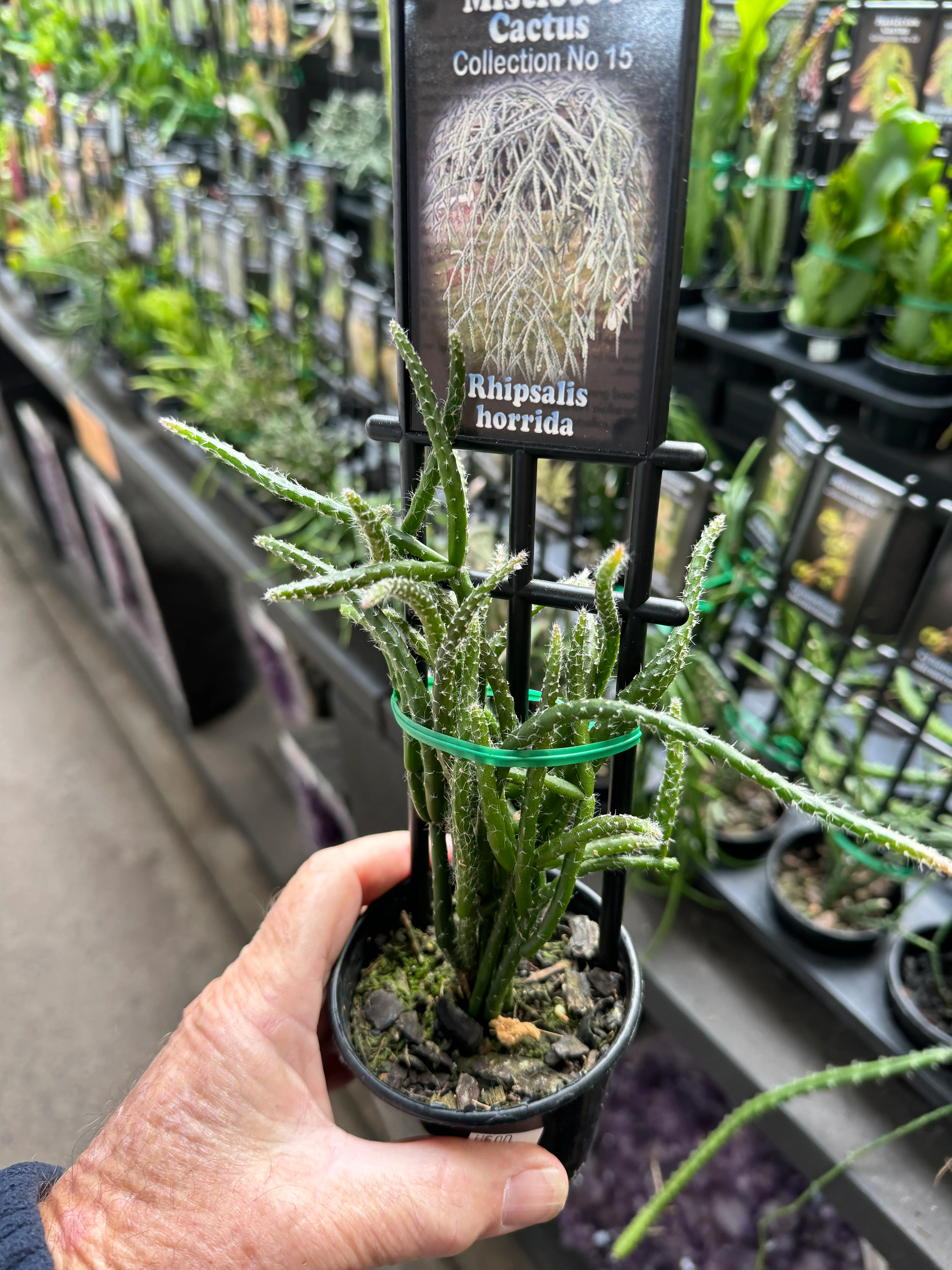
The stems are long, cylindrical, and noticeably more bristly than other subspecies, with numerous stiff, hair-like spines emerging from the areoles. This gives the plant a slightly rougher texture compared with the smoother forms. Branching occurs irregularly from the tips, creating extensive trailing growth over time.
Small, white flowers appear along the stems, followed by rounded, translucent to whitish berries. These are consumed by birds, which aid in dispersing the seeds through the forest canopy.
Care Tips:
- Light: Prefers bright, indirect light; avoid prolonged direct sun which may scorch stems.
- Water: Keep evenly moist during the growing season, allowing the surface of the media to dry slightly between waterings; reduce watering in winter.
- Humidity: Benefits from moderate to high humidity; mist occasionally if indoor air is dry.
- Media: Use a free-draining mix with fine orchid bark, peat or coir, and perlite.
- Temperature: Maintain between 15–27°C; protect from frost.
- Fertiliser: Feed every 4–6 weeks in the growing season with a diluted, balanced fertiliser.
- Repotting: Repot every 2–3 years or when root-bound, preferably in spring.
Original: $12.00
-65%$12.00
$4.20More Images

Rhipsalis baccifera subsp. horrida - Mistletoe Cactus
Rhipsalis baccifera subsp. horrida, commonly known as the Mistletoe Cactus, is a subspecies of the widespread Rhipsalis baccifera, native to parts of South America including Brazil. It is found in warm, humid, and shaded habitats, most often growing on trees in forested areas where it receives filtered light and benefits from high atmospheric moisture.
The stems are long, cylindrical, and noticeably more bristly than other subspecies, with numerous stiff, hair-like spines emerging from the areoles. This gives the plant a slightly rougher texture compared with the smoother forms. Branching occurs irregularly from the tips, creating extensive trailing growth over time.
Small, white flowers appear along the stems, followed by rounded, translucent to whitish berries. These are consumed by birds, which aid in dispersing the seeds through the forest canopy.
Care Tips:
- Light: Prefers bright, indirect light; avoid prolonged direct sun which may scorch stems.
- Water: Keep evenly moist during the growing season, allowing the surface of the media to dry slightly between waterings; reduce watering in winter.
- Humidity: Benefits from moderate to high humidity; mist occasionally if indoor air is dry.
- Media: Use a free-draining mix with fine orchid bark, peat or coir, and perlite.
- Temperature: Maintain between 15–27°C; protect from frost.
- Fertiliser: Feed every 4–6 weeks in the growing season with a diluted, balanced fertiliser.
- Repotting: Repot every 2–3 years or when root-bound, preferably in spring.
Product Information
Product Information
Shipping & Returns
Shipping & Returns
Description
Rhipsalis baccifera subsp. horrida, commonly known as the Mistletoe Cactus, is a subspecies of the widespread Rhipsalis baccifera, native to parts of South America including Brazil. It is found in warm, humid, and shaded habitats, most often growing on trees in forested areas where it receives filtered light and benefits from high atmospheric moisture.
The stems are long, cylindrical, and noticeably more bristly than other subspecies, with numerous stiff, hair-like spines emerging from the areoles. This gives the plant a slightly rougher texture compared with the smoother forms. Branching occurs irregularly from the tips, creating extensive trailing growth over time.
Small, white flowers appear along the stems, followed by rounded, translucent to whitish berries. These are consumed by birds, which aid in dispersing the seeds through the forest canopy.
Care Tips:
- Light: Prefers bright, indirect light; avoid prolonged direct sun which may scorch stems.
- Water: Keep evenly moist during the growing season, allowing the surface of the media to dry slightly between waterings; reduce watering in winter.
- Humidity: Benefits from moderate to high humidity; mist occasionally if indoor air is dry.
- Media: Use a free-draining mix with fine orchid bark, peat or coir, and perlite.
- Temperature: Maintain between 15–27°C; protect from frost.
- Fertiliser: Feed every 4–6 weeks in the growing season with a diluted, balanced fertiliser.
- Repotting: Repot every 2–3 years or when root-bound, preferably in spring.