Melocactus azureus – Turk's Cap Cactus
Melocactus azureus, commonly known as the Turk’s Cap Cactus, is native to the rocky grasslands and savannahs of Minas Gerais, Brazil. Its blue-green epidermis and the woolly cephalium that appears at maturity make it one of the more distinctive members of the genus. The cephalium, which produces small pink flowers, is the feature that gives rise to its common name.
In its juvenile stage, M. azureus forms a solitary, globular to short cylindrical stem with pronounced ribs and evenly spaced spines. Once mature, the stem stops elongating and growth continues through the cephalium, which gradually increases in height and produces seasonal flowers. Brightly coloured fruits emerge from the cephalium after pollination, contrasting sharply with the surrounding wool.
This species thrives when given full sun and a sharply draining, mineral-based substrate. It is drought-tolerant once established but benefits from careful watering during its summer growth period. As with all Melocactus, it is sensitive to cold and should be kept in a warm, frost-free position year-round to protect both the roots and cephalium.
Care Tips:
- Light: Full sun or very bright light for strong growth and best colour.
- Water: Water sparingly, allowing soil to dry between waterings; increase slightly during summer growth.
- Humidity: Prefers low humidity and good airflow.
- Media: Use a free-draining cactus mix with added grit or sand.
- Fertiliser: Apply a low-nitrogen cactus fertiliser during the active growing season.
- Temperature: Maintain above 15 °C; protect from frost and prolonged cool conditions.
- Repotting: Repot infrequently, as Melocactus are sensitive to root disturbance.
More Images


Melocactus azureus – Turk's Cap Cactus
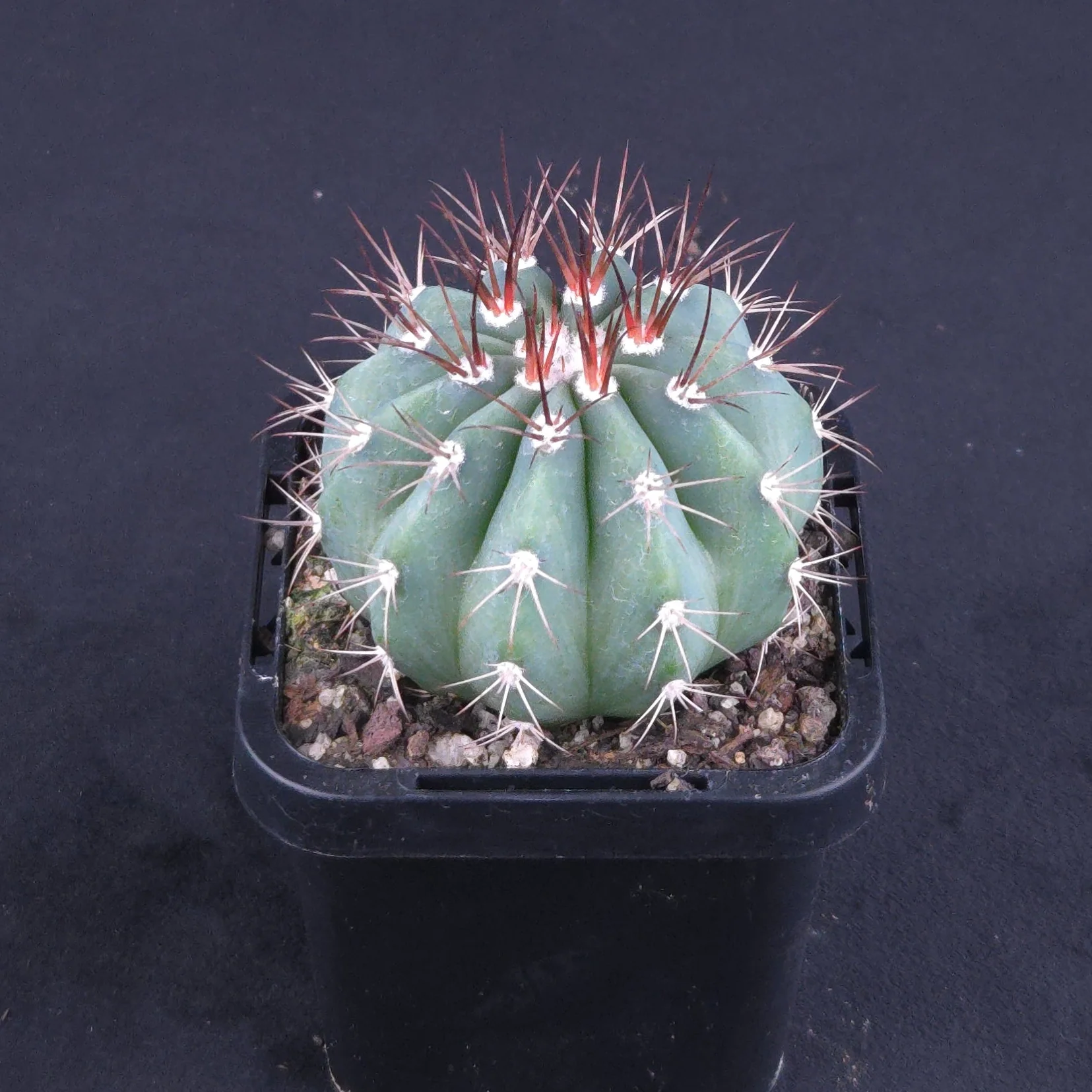
Melocactus azureus, commonly known as the Turk’s Cap Cactus, is native to the rocky grasslands and savannahs of Minas Gerais, Brazil. Its blue-green epidermis and the woolly cephalium that appears at maturity make it one of the more distinctive members of the genus. The cephalium, which produces small pink flowers, is the feature that gives rise to its common name.
In its juvenile stage, M. azureus forms a solitary, globular to short cylindrical stem with pronounced ribs and evenly spaced spines. Once mature, the stem stops elongating and growth continues through the cephalium, which gradually increases in height and produces seasonal flowers. Brightly coloured fruits emerge from the cephalium after pollination, contrasting sharply with the surrounding wool.
This species thrives when given full sun and a sharply draining, mineral-based substrate. It is drought-tolerant once established but benefits from careful watering during its summer growth period. As with all Melocactus, it is sensitive to cold and should be kept in a warm, frost-free position year-round to protect both the roots and cephalium.
Care Tips:
- Light: Full sun or very bright light for strong growth and best colour.
- Water: Water sparingly, allowing soil to dry between waterings; increase slightly during summer growth.
- Humidity: Prefers low humidity and good airflow.
- Media: Use a free-draining cactus mix with added grit or sand.
- Fertiliser: Apply a low-nitrogen cactus fertiliser during the active growing season.
- Temperature: Maintain above 15 °C; protect from frost and prolonged cool conditions.
- Repotting: Repot infrequently, as Melocactus are sensitive to root disturbance.
Product Information
Product Information
Shipping & Returns
Shipping & Returns
Description
Melocactus azureus, commonly known as the Turk’s Cap Cactus, is native to the rocky grasslands and savannahs of Minas Gerais, Brazil. Its blue-green epidermis and the woolly cephalium that appears at maturity make it one of the more distinctive members of the genus. The cephalium, which produces small pink flowers, is the feature that gives rise to its common name.
In its juvenile stage, M. azureus forms a solitary, globular to short cylindrical stem with pronounced ribs and evenly spaced spines. Once mature, the stem stops elongating and growth continues through the cephalium, which gradually increases in height and produces seasonal flowers. Brightly coloured fruits emerge from the cephalium after pollination, contrasting sharply with the surrounding wool.
This species thrives when given full sun and a sharply draining, mineral-based substrate. It is drought-tolerant once established but benefits from careful watering during its summer growth period. As with all Melocactus, it is sensitive to cold and should be kept in a warm, frost-free position year-round to protect both the roots and cephalium.
Care Tips:
- Light: Full sun or very bright light for strong growth and best colour.
- Water: Water sparingly, allowing soil to dry between waterings; increase slightly during summer growth.
- Humidity: Prefers low humidity and good airflow.
- Media: Use a free-draining cactus mix with added grit or sand.
- Fertiliser: Apply a low-nitrogen cactus fertiliser during the active growing season.
- Temperature: Maintain above 15 °C; protect from frost and prolonged cool conditions.
- Repotting: Repot infrequently, as Melocactus are sensitive to root disturbance.